
On this page
- Quick answer
- How Much Does the Nar Phu Trek Cost in 2027?
- What the Nar Phu Trek Package Includes
- Food Cost on the Nar Phu Trek
- Extra Daily Expenses
- How Much Cash to Carry for the Nar Phu Trek
- Travel Insurance Cost
- Gear Cost: Rent or Buy
- How Season Affects Nar Phu Trek Cost
- How to Reduce Your Nar Phu Trek Budget
- Questions and answers
- Package
- USD 470–1,150 per person
- Trip length
- 10, 12 or 16 days
- Permit
- USD 75–100 per week
- Cash on the trail
- USD 22–30 per day
Quick answer
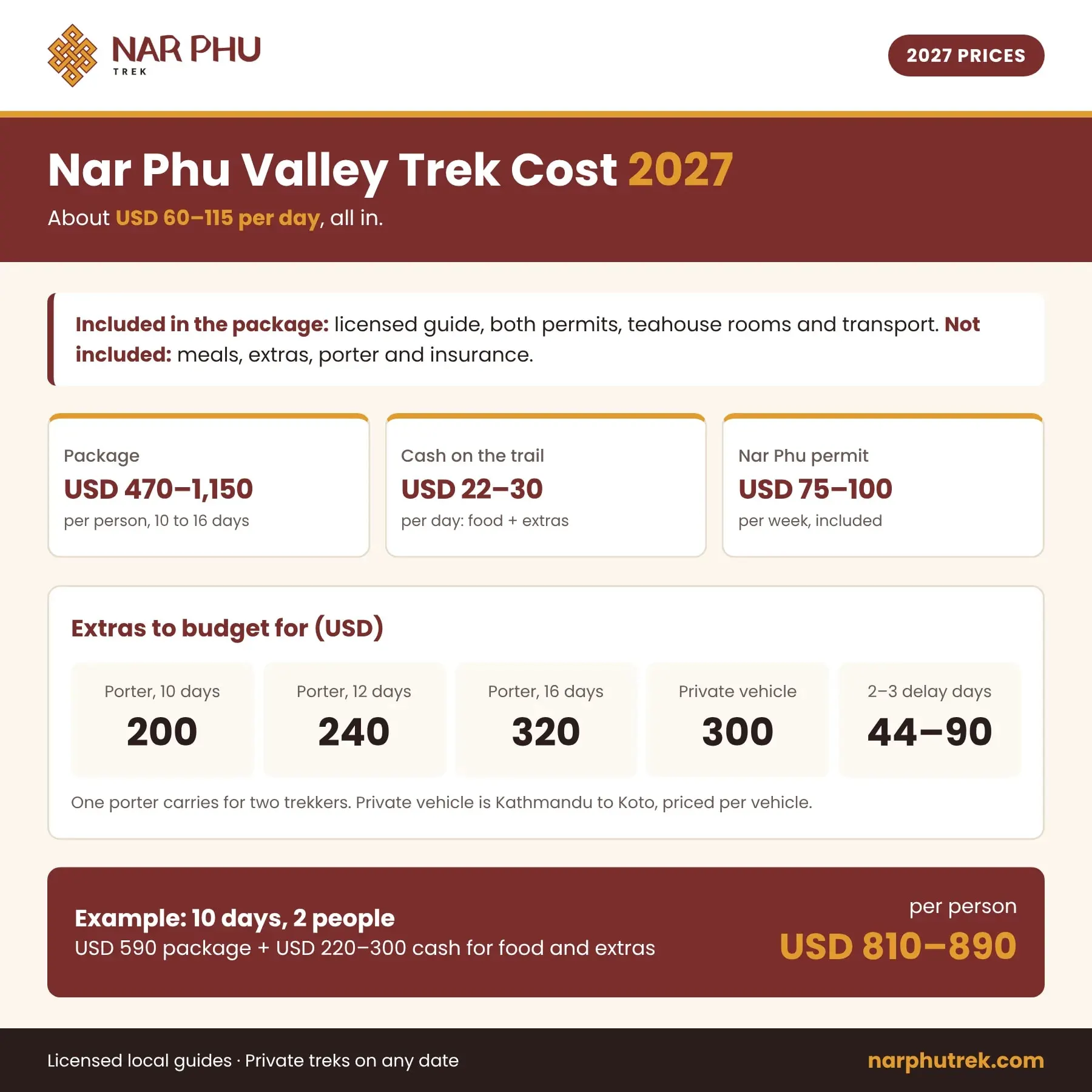
The Nar Phu Valley Trek costs about USD 60 to 115 per day in 2027, all in. Our package costs USD 470 to 1,150 per person, depending on trip length and group size. On top of that, budget USD 22 to 30 a day in cash for food and extras, plus tips.
The Nar Phu Valley trek costs about USD 60 to 115 per day in 2027. Where you land in that range depends on how many days you trek, your group size, and the services you want. This daily figure is your total trip cost. It includes permits, food, a licensed guide, transport from Kathmandu or Pokhara, accommodation, a first aid kit, and small extras like hot showers, hot water, charging, and Wi-Fi. It does not cover tips or international flights.
Nar Phu costs more than most teahouse treks because it is a restricted area in Manang District, close to the Tibet border. You need a special Restricted Area Permit, and you must trek with a licensed guide through a registered agency.
How Much Does the Nar Phu Trek Cost in 2027?
Our 2027 Nar Phu package costs USD 470 to 1,150 per person. The price depends on two things: how long you trek and how many people are in your group. A solo trekker pays the most because one person covers the full cost of the guide and transport. In a group, these costs are shared, so the price per person drops.
We offer three trip lengths:
10 days: The standard Nar Phu loop. You drive from Kathmandu to Koto (2,620 m), trek to Phu (4,080 m) and Nar (4,110 m), cross Kang La Pass (5,320 m), and drive back from Ngawal (3,650 m).
12 days: A relaxed version of the same route. Walking days are shorter, about 3 to 5.5 hours, and you get extra time in the villages. The Kang La Pass day still takes about 10 hours.
16 days: Nar Phu combined with the Annapurna Circuit. After Kang La, you continue through Manang, visit Tilicho Lake (4,919 m), and cross Thorong La Pass (5,416 m) to Muktinath, then drive to Pokhara and Kathmandu.
| Group size | 10 days (USD per person) | 12 days (USD per person) | 16 days with Annapurna Circuit (USD per person) |
|---|---|---|---|
| 1 person | 835 | 999 | 1,150 |
| 2 people | 590 | 670 | 750 |
| 3 to 5 people | 550 | 620 | 635 |
| 6 to 8 people | 530 | 600 | 642 |
| 9 or more people | 470 | 530 | 560 |
The package price is not your full trip cost. You also pay for your meals, hot showers, charging, drinking water, and tips while you trek. For example, two people on the 12-day trek pay USD 670 each for the package. Each person then needs about USD 264 to 360 (about NPR 39,864 to 54,360) in cash for food and extras, plus a recommended tip of about USD 100 each. That brings the total to roughly USD 1,034 to 1,130 per person.
 Nar Phu Valley Trek10 days · Challenging · from $550
What the Nar Phu Trek Package Includes
The package covers the three biggest costs of the trek: your accommodation, your licensed guide, and your ground transport. It also covers both permits, so you do not need to deal with any paperwork in Kathmandu.
Transport. You ride a local vehicle from Kathmandu (1,400 m) to Besisahar (760 m), a 176 km drive of about 7 hours. From Besisahar, a local jeep takes you up the Marsyangdi valley to Koto (2,620 m), where the trek starts. The full drive from Kathmandu to Koto is about 236 km and takes about 11.5 hours. On the 10-day and 12-day treks, a local jeep brings you back from Ngawal (3,650 m) to Ngadi and a local vehicle takes you on to Kathmandu. On the 16-day trek, you finish at Muktinath (Ranipauwa) and drive to Pokhara and Kathmandu in local vehicle.
Accommodation: Family-run mountain teahouses during the trek, with twin-bed rooms and shared toilets. In Nar Phedi, you stay at the monastery guest lodge. For Annapurna Circuit additional, we have included 3 star hotel stay in Pokhara as well.
Guide and safety. You trek with a government-certified, English-speaking guide. Groups of 6 to 8 or more trekkers get a second guide. Once you share your high-altitude insurance details with us, we can also arrange a helicopter rescue if you need one.
Permits and extras. The package includes the Nar Phu Restricted Area Permit, the Annapurna Conservation Area Permit (ACAP, NPR 3,000 for foreigners and NPR 1,000 for SAARC nationals), and all government taxes. You do not need a TIMS card on this route. You also get a bottle for hot water at night, a trekking map, a sun hat, a first aid kit, and a trip completion certificate.
Not included:
Meals (breakfast, lunch, and dinner)
Hot showers, device charging, Wi-Fi, drinks, and phone calls
A porter, or a private vehicle instead of the local jeep (see prices below)
Tips for your guide and porter
Personal high-altitude travel insurance
Your Nepal visa and international flights
Bank charges for international payments
Extra nights if the itinerary changes because of weather or road problems
The Jomsom to Pokhara flight on the 16-day trek, if you choose to fly instead of drive
Why We Generally Don’t Include Meals in Our Trekking Package
Our standard trekking packages exclude meals so you can choose what to eat based on your appetite, preferences, and dietary needs. You order directly from teahouses and pay for your meals, giving you clear control over your food expenses. This approach supports local teahouse owners and the families who provide food and accommodation along the trail. Meal prices vary by location because transporting supplies to higher elevations costs more. It also helps reduce food waste by allowing you to order only what you want.
Optional Extras at Extra Cost
You can hire a porter or book a private vehicle instead of the local jeep. These are not part of the package price.
| Optional service | Cost (USD) |
|---|---|
| Porter, 10-day trek | 200 |
| Porter, 12-day trek | 240 |
| Porter, 16-day trek | 320 |
| Private vehicle, Kathmandu to Koto | 300 per vehicle |
| Private vehicle, Ngawal to Kathmandu (10 and 12 days) | 420 per vehicle |
| Private vehicle, Muktinath to Pokhara (16 days) | 200 per vehicle |
| Private vehicle, Pokhara to Kathmandu (16 days) | 200 per vehicle |
A porter carries your main bag, so you only walk with a small daypack. One porter usually carries for two trekkers, so two people can share the cost. This makes long, steep days easier, such as the 8-hour walk from Phu to Nar Phedi and the climb from Nar to Kang La Pass (5,320 m).
The private vehicle price is per vehicle, not per person, so your group shares it. For example, four trekkers who book private vehicles both ways pay USD 720 in total, or USD 180 each. A private vehicle is faster and more comfortable than the local jeep, and you can stop for photos along the Marsyangdi valley. The Ngawal to Kathmandu option applies to the 10-day and 12-day treks. The 16-day trek ends at Muktinath, so you can book a private vehicle from Muktinath to Pokhara and from Pokhara to Kathmandu instead.
Food Cost on the Nar Phu Trek
Budget USD 17 to 25 per day for food on the Nar Phu trek. This covers breakfast, lunch, and dinner at the teahouses. Food is your biggest out-of-pocket cost, because the package already pays for your room, guide, and transport.
Dal bhat gives you the best value. It is a plate of rice, lentil soup, vegetable curry, and pickle, and most lodges refill your plate for free. Many trekkers eat it twice a day because it is filling and gives steady energy for long, cold days on the trail.
Other dishes cost more. Pasta, pizza, chips, and imported snacks are more expensive because lodges must bring in the ingredients from far away. If you prefer non-local food or have a big appetite, budget around USD 25 a day.
Typical Menu Prices
Menu prices on the Nar Phu trek go up as you get farther from the road. Phu and Nar have no road access, so mules, yaks, and porters carry in almost all food. A plate of dal bhat costs roughly USD 6.
The ranges below are approximate. Each lodge sets its own prices, so expect the lower end near Koto and the higher end in Phu, Nar, and Nar Phedi.
| Item | Approximate price (NPR) |
|---|---|
| Dal bhat (with refills) | 800 to 1,000 |
| Noodles or fried rice | 600 to 800 |
| Eggs (one plate) | 400 to 600 |
| Tea (one cup) | 100 to 200 |
| Coffee (one cup) | 200 to 250 |
A typical day looks like this: eggs and tea for breakfast, dal bhat for lunch, and dal bhat or noodles for dinner.
Drinking Water Cost
Boiled hot water from the lodge is the safest and most practical choice, and it costs about USD 1.5 per liter. The price is higher in Phu and Nar because lodges burn more fuel to boil water at over 4,000 m.
Bottled water is the option to avoid. The Annapurna Conservation Area has limited waste collection, and empty plastic bottles often end up burned or dumped near villages. Bottles are also hard to find in Phu and Nar.
A water filter or purification tablets cut your water cost the most. You can fill up from village taps and streams for free, then treat the water yourself. Over a 12-day trek, this can save you several thousand rupees.
Extra Daily Expenses
Budget about USD 5 per day for extra services on the trek. These small costs add up because almost nothing is free above Koto.
Hot shower: Included in the USD 5 daily extras budget. Many lodges in Phu and Nar have solar or gas showers, but hot water may run out on cloudy days.
Device charging: Included in the USD 5 daily extras budget. Some lodges charge nothing, and lodges that rely on solar power charge more.
Hot drinking water: About USD 1.5 per liter, as above.
Wi-Fi is limited or not available in Phu and Nar, and mobile signal is weak in much of the valley. Do not plan to work online during the trek. A 20,000 mAh power bank lets you charge your phone and camera without paying at every lodge. Keep it in your sleeping bag at night, because cold drains batteries fast at Phu (4,080 m) and Nar (4,110 m).
How Much Cash to Carry for the Nar Phu Trek
Carry USD 22 to 30 (about NPR 3,322 to 4,530) in cash for each day of the trek. This covers USD 17 to 25 (about NPR 2,567 to 3,775) for meals and about USD 5 (about NPR 755) for hot showers, Wi-Fi, and charging. Rupee amounts use the current rate of USD 1 = NPR 151. Your actual spending depends on what you eat and how often you use these extras.
Lodges in Koto, Meta, Kyang, Phu, Nar, and Ngawal only take cash in Nepali rupees. They do not accept cards, and most cannot change US dollars or other foreign currency. Bring small notes too, because lodges in remote villages often do not have change for large notes.
Withdraw all the cash you need in Kathmandu or Besisahar before you start. There are no ATMs inside the valley, and the last reliable ones are in Besisahar and Chame. For a 12-day trek, plan to carry USD 264 to 360 (about NPR 39,864 to 54,360), plus extra for delay days and tips.
Budget for Delay Days
Add money for 2 to 3 extra days, which comes to about USD 44 to 90 (about NPR 6,644 to 13,590) in cash. Mountain weather and road problems can hold you up, and you still pay for meals while you wait.
These are the most common reasons for delays:
Snow on Kang La Pass (5,320 m): Fresh snow can make the climb from Nar unsafe. Your guide may ask you to wait a day in Nar until the trail is clear.
Landslides on the road to Koto: The jeep road through Jagat, Tal, and Dharapani is rough and off-road. Rain can block it, especially in the monsoon.
Shoulder-season weather: Late November and early March can bring sudden cold and storms, which slow down the pass crossing.
Extra nights caused by these delays are not included in the package. You may also need to pay for your room on those nights, so keep some cash aside for it.
Tipping Your Guide and Porter
Tips are not part of the daily budget, so plan for them separately. We recommend a tip of 15% of your package price per person. For example, if your 12-day package costs USD 670, plan to tip about USD 100. On the 16-day trek for two people (USD 750 each), that is about USD 113 each.
If you hire a porter, split the tip between your guide and your porter. Many trekkers give the guide a slightly larger share because the guide leads the group and handles the permits. In a group, everyone usually adds to one shared tip.
Give tips at the end of the trek, often on the last evening or back in Kathmandu. Hand the money to each person directly, in an envelope if you like, with a few words of thanks. You can tip in Nepali rupees or US dollars.
Travel Insurance Cost
You need travel insurance that covers trekking to at least 5,500 m, because Kang La Pass sits at 5,320 m. If you choose the 16-day trek with the Annapurna Circuit, you also cross Thorong La Pass at 5,416 m, so check that your policy covers that height too. Many standard travel policies stop at much lower altitudes and do not cover trekking at all.
Your policy must include helicopter evacuation. Phu and Nar are a long walk from the nearest road, so a helicopter is often the only fast way out if you get altitude sickness or an injury. A helicopter rescue flight to Kathmandu can cost USD 3,000 to 6,000 without insurance. Rescues also depend on the weather and can take hours.
The price of a policy depends on your age, your home country, your trip length, and the altitude limit. Get quotes from a few insurers that cover high-altitude trekking in Nepal. Before you buy, check these points:
- The altitude limit is at least 5,500 m.
- Helicopter evacuation and emergency medical care are covered.
- Trip cancellation and delays are covered.
- You know how to contact the insurer's emergency team. Some insurers must approve a helicopter rescue first.
Send us your policy details before the trek. We need them to arrange a helicopter rescue for you in an emergency.
Gear Cost: Rent or Buy
Renting is the cheapest choice for big, warm items you will not use again soon. Shops in Thamel and Pokhara rent down jackets and sleeping bags for about USD 1 to 2 per item per day. For a 12-day trek, renting both costs about USD 24 to 48.
Buying makes sense if you trek often. A locally made down jacket in Thamel costs about USD 20 to 80. Sleeping bag costs around USD 60+. Check the stitching, zips, and filling before you buy, since quality varies a lot between shops.
These items are worth spending on for a cold, high pass crossing:
A warm sleeping bag: Nights in Phu (4,080 m) and Nar (4,110 m) drop below freezing, and teahouse rooms have no heating.
A down jacket: You need it every evening and on the pre-dawn start for Kang La Pass.
Trekking poles: They protect your knees on the very steep 1,670 m descent from Kang La to Ngawal.
Broken-in boots: Buy or bring these from home. New boots cause blisters on long days like Phu to Nar Phedi (about 8 hours).
Warm gloves, a hat, and thermal layers: These are cheap but make a big difference at 5,000 m.
How Season Affects Nar Phu Trek Cost
Autumn (September to November) is the most expensive season, because the Restricted Area Permit costs the most and demand is highest. The permit costs USD 100 per person for the first week from September to November, plus USD 15 for each extra day. From December to August, it costs USD 75 per week, plus USD 15 for each extra day. For example, a 9-day stay in October costs USD 130. SAARC nationals pay the same fee as other foreigners.
| Season | Months | Permit fee (per week) | Trail conditions |
|---|---|---|---|
| Autumn | September to November | USD 100 | Clear skies, stable weather, best views of Himlung Himal, Kang Guru, and the Annapurnas. Busiest season. |
| Spring | March to May | USD 75 | Warmer days and good conditions on Kang La. Lower permit fee and fewer trekkers. |
| Winter | December to February | USD 75 | Very cold. Heavy snow often closes Kang La Pass, and some lodges may close. |
| Monsoon | June to August | USD 75 | Less rain in the upper valley, but landslides often block the road to Koto. Cloud hides views. |
Spring gives the best balance of cost and conditions. You pay less for the permit, and Kang La Pass is usually open. Winter and the monsoon also have the lower fee, but delays are more likely, so you may spend more on extra days.
How to Reduce Your Nar Phu Trek Budget
The easiest ways to save money are to eat local food and plan your trek for spring.
Eat dal bhat. Free refills make it the cheapest way to stay full. Sticking to local meals keeps your food budget close to USD 17 a day.
Carry a water filter and a power bank. These cut the daily cost of hot water and charging.
Rent gear in Thamel. Renting a down jacket and sleeping bag costs far less than buying new ones at home.
Questions and answers
How much does the Nar Phu Valley Trek cost in 2027?
Our package costs USD 470 to 1,150 per person, depending on trip length (10, 12 or 16 days) and group size. All in, with food and extras, the trek costs about USD 60 to 115 per day.
How much is the Nar Phu Restricted Area Permit?
From September to November it costs USD 100 for the first 7 days, plus USD 15 per extra day. From December to August it costs USD 75 for the first 7 days, plus USD 15 per extra day. Both permits are included in our package.
Can I trek Nar Phu without a guide?
No. Nar Phu is a restricted area, so you must trek with a licensed guide through a registered agency. Groups of 6 to 8 or more trekkers get a second guide.
Are meals included in the Nar Phu trek package?
No. Meals are not included, so you choose and pay for your own food at the teahouses. Budget USD 17 to 25 per day for breakfast, lunch, and dinner.
How much cash should I carry for the Nar Phu trek?
Carry USD 22 to 30 (about NPR 3,322 to 4,530) per day in Nepali rupees. For a 12-day trek, that is USD 264 to 360, plus 2 to 3 delay days and tips. There are no ATMs inside the valley.
How much should I tip my guide and porter?
We recommend 15% of your package price per person. On a 12-day package of USD 670, that is about USD 100.
What travel insurance do I need for Nar Phu?
Your policy must cover trekking to at least 5,500 m and include helicopter evacuation. A rescue flight to Kathmandu can cost USD 3,000 to 6,000 without insurance.
Do I need a TIMS card for the Nar Phu trek?
No. You only need the Nar Phu Restricted Area Permit and the Annapurna Conservation Area Permit (ACAP).
Was this helpful?